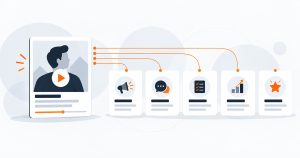










2D animation services produce flat, screen-based animation that explains something, from motion graphics and explainer videos to illustrated and character-led work. In B2B, the point is simple: animation makes a complex or technical product clear, with no crew, no location and no reshoot. If a camera cannot show your product, because it is software, data or a process, animation can.
That is why it fits B2B so well. Your buyer is often trying to understand something abstract before they can decide. Good 2D animation removes the effort.
Key Takeaways
- 2D animation services produce flat, screen-based animation, from motion graphics to explainer and character work, that makes a complex or technical product clear without a film crew, a location or a reshoot.
- Motion graphics is the most common 2D style in B2B, because the subject is usually software, data or a process, which a camera cannot show but animation can.
- The style follows the job: motion graphics for data and process, explainer animation for a single problem and solution, character animation for story and empathy, kinetic typography for fast social messaging.
- The animatic is the checkpoint. Fixing pacing at the storyboard-on-a-timeline stage is cheap; fixing it after full animation is not.
- Room4 Media makes B2B 2D animation from studios in Madrid and Bogotá, including an animated open banking explainer for Deloitte and a 1.5-minute CBAM explainer for European Aluminium.
What 2D animation is used for in B2B
Animation is not one deliverable. It does different jobs across the buyer journey.
| Use case | What the animation does |
|---|---|
| Product and service explainers | Turn a complex offer into one clear problem and solution in under two minutes |
| SaaS and platform demos | Show how software works on screen, without recording a live UI walkthrough |
| Lead generation and conversion | Short, punchy assets for landing pages, email and paid social that lift engagement |
| Sales enablement | Animated sequences inside decks, proposals and webinars that keep attention on the point |
| Training and onboarding | Step-by-step visual guides that are easier to follow, and cheaper to update, than filmed ones |
| Brand storytelling | A branded piece that carries a message and a feeling, not just information |
The common thread is clarity. Each of these takes something a prospect would otherwise have to work to understand and makes it land fast.
The main styles of 2D animation
The style follows the job. Choosing the right one is most of the decision.
| Style | What it is | Best for |
|---|---|---|
| Motion graphics | Animated icons, charts, typography and shapes | Data, process, software, and abstract concepts |
| Explainer animation | Short, script-led, one problem and one solution | Top-of-funnel product and service explainers |
| Flat and vector illustration | Clean, modern illustrated scenes | SaaS and corporate brands that want a polished look |
| Character-led animation | Animated characters carrying a story | Empathy, narrative, and human-centred messages |
| Kinetic typography and infographic | Fast-moving text and animated data | Short social messaging and stat-led posts |
| Whiteboard | Hand-drawn, step-by-step reveal | Education and sequential how-it-works content |
Motion graphics is the most-used 2D style in B2B, and the reason is practical: the subject is usually software, data or a workflow, and motion graphics is built to show exactly that.
How 2D animation is made
It runs in three phases, and knowing them helps you brief better and spot a studio that has a real process.
Pre-production is where the thinking happens: the script, the storyboard, then the animatic, which is the storyboard set to a timeline so you can test the pacing before anything is animated. Character, icon and background design happen here too. Production is the making: layout, animation, compositing and effects, either drawn frame by frame or rigged as vectors. Post-production adds the voiceover, sound design, music and final polish, then exports the files.
The animatic is the checkpoint that matters. Fixing pacing at the animatic stage is cheap, because nothing is animated yet. Fixing it after full animation is expensive. A studio that skips the animatic is one to question.
Do you need animation or live action
Both have their place, so match the format to the subject.
Choose 2D animation when the thing you are explaining cannot be filmed: software, data, a process, an abstract idea, or a future state that does not exist yet. It is also the better call when you need to update the content later, or produce a set of consistent pieces, because there is no crew, location or reshoot to schedule.
Choose live action when the value is in real people, a real place, or a physical product a camera can capture, a testimonial, an event, or a product demo you can hold. Many B2B campaigns use both: live action for the human proof, animation for the parts a camera cannot reach.
How to choose a 2D animation studio
- Range of styles. Ask to see motion graphics, explainer and illustrated work, not one style dressed up as versatility.
- A real process. They should walk you through pre-production, the animatic, production and post. Vague answers are the warning sign.
- B2B experience. Explaining a regulated or technical product is a different skill from entertainment animation. Ask for work in your world.
- The reel and named work. A credible studio leads with the actual output and real clients, not adjectives.
- Scope, not a fixed week count. Timelines vary by scope; a good studio scopes your project rather than promising a generic turnaround.
How Room4 Media makes B2B animation
Room4 Media is the team that makes your B2B content, from studios in Madrid and Bogotá, delivering globally. We produce the full range of 2D animation: motion graphics, explainer, illustrated and character work, built to make a complex message clear.
For Deloitte, we made a 2D animated explainer on open banking for a UK finance audience: what open banking means, how the banking landscape is changing, and the impact it could have on the market. The subject is abstract and regulatory, exactly the kind of thing a camera cannot show, so we used a simple, linear art direction to make a complex concept easy to follow.
For European Aluminium, we made a 1.5-minute animated explainer on the Carbon Border Adjustment Mechanism. Their written papers, dense with statistics, were not reaching time-poor, non-technical EU policymakers. The animation turned a technical argument into something understood in under two minutes, and reached a wider group of policymakers.
Two sectors, one job: 2D animation making a complex subject clear. See more of our B2B video and animation, or our cleantech and industrial work.
If you have a product or a message that is hard to explain in words, start a conversation with Room4 Media about the animation that makes it clear.