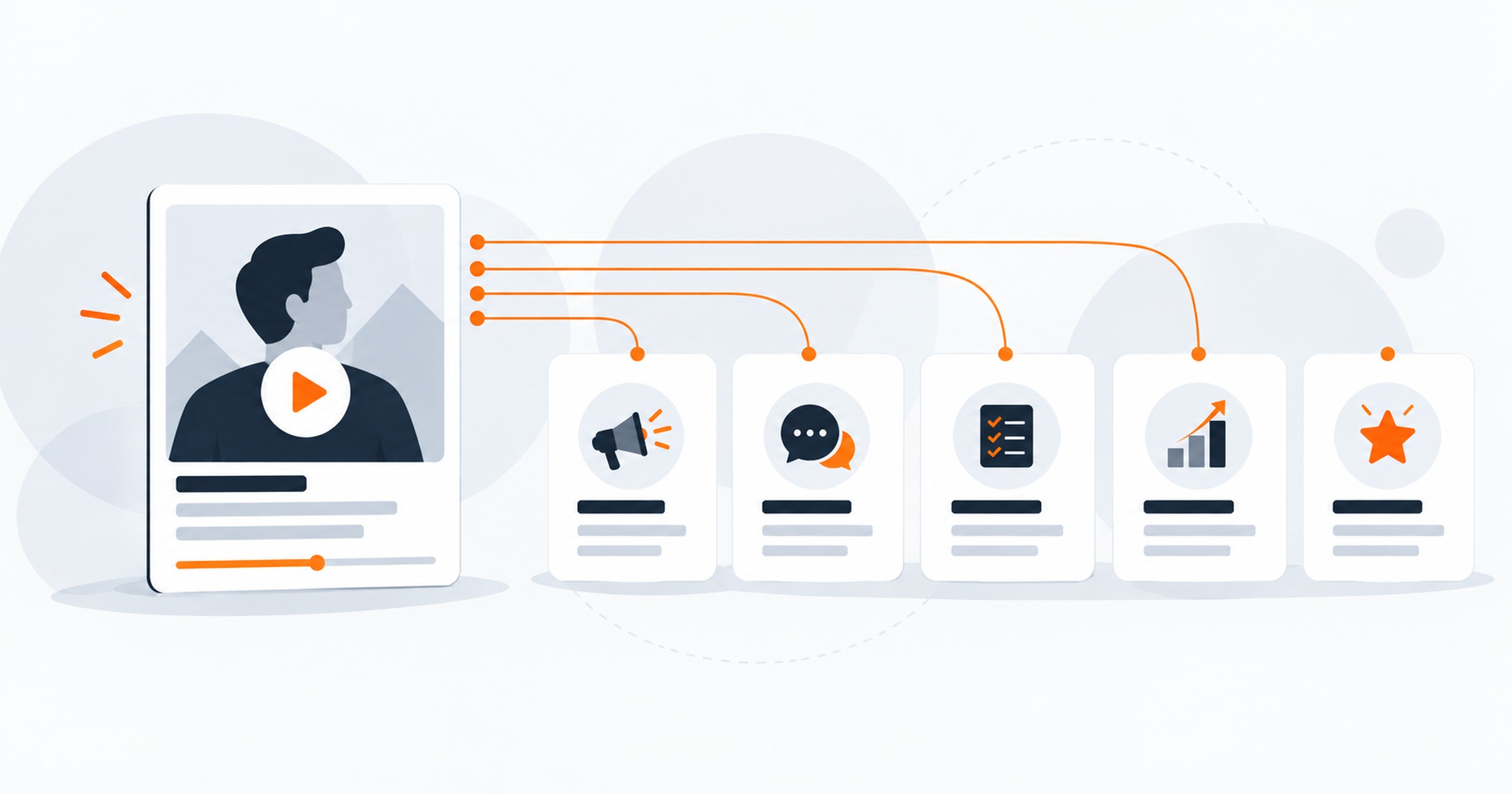
Video can help your business explain complex ideas, build trust, and move buyers closer to a decision. But video only works when it has a clear strategy behind it.
A strong video marketing strategy defines who you need to reach, what they need to understand, which videos you should create, where each video should be used, and how success will be measured.
Without that plan, video becomes another isolated marketing asset. With the right plan, it becomes part of a wider content system that supports awareness, trust, sales conversations, and customer retention.
What is a video marketing strategy?
A video marketing strategy is a plan for using video to support clear business goals. It connects your message, audience, buyer journey, content formats, distribution channels, and performance metrics.
It answers five key questions:
- Who are we trying to reach?
- What do they need to understand?
- What action do we want them to take?
- Which type of video will help them move forward?
- How will we know if the video worked?
Why your business needs a video marketing strategy
Anyone can create a video. That does not mean the video will help your business grow.
A clear video strategy helps you avoid wasted production, scattered messages, and content that looks good but does not support the buyer journey.
For B2B companies with complex products or services, this matters even more. Your audience may need to understand technical value, commercial impact, risk, timing, and internal buy-in before they act.
Video can make that process easier, but only when it is built around the right message and used at the right stage.
Step 1: Define the business goal
Start with the outcome, not the format.
Before you decide to create an explainer video, brand film, customer story, product demo, or campaign video, define what the video needs to achieve.
Your goal might be to:
- Increase awareness in a specific market
- Explain a complex product or service
- Improve lead quality
- Support sales conversations
- Reduce repeated explanations during calls
- Help internal teams align around one clear message
- Build trust with buyers, investors, or stakeholders
The clearer the goal, the easier it becomes to choose the right video format.
Step 2: Understand your audience
Your video should not begin with what you want to say. It should begin with what your audience needs to hear.
Ask:
- Who is watching?
- What do they already understand?
- What are they confused about?
- What problem are they trying to solve?
- What do they need to believe before they act?
- What objections could stop them from moving forward?
This is where many businesses lose clarity. They explain the product from the inside out instead of translating value from the audience’s point of view.
The goal is simple: make the right people understand you faster.
Step 3: Clarify the message
Your message is the foundation of the video.
Before production starts, define the core idea in one clear sentence. If your team cannot explain the message simply, the video will struggle to do it for you.
A strong video message should explain:
- The problem your audience faces
- Why that problem matters
- How your business helps solve it
- Why is your approach different
- What the viewer should do next
This is especially important for B2B companies. Buyers do not need more information. They need the right information, in the right order, with a clear reason to care.
Step 4: Map video to the buyer journey
Different stages need different videos.
A buyer who has never heard of your business does not need the same content as someone comparing vendors or preparing an internal business case.
Use video across the journey like this:
Awareness:
Use short videos, brand films, thought leadership clips, and problem-led explainers to help people recognize the issue and understand why it matters.
Consideration:
Use product explainers, service overview videos, comparison content, and educational videos to clarify your value and answer key questions.
Decision:
Use customer stories, demos, sales enablement videos, and proof-led content to build confidence and reduce risk.
Retention:
Use onboarding videos, training content, product education, and customer success stories to support existing clients and improve long-term value.
This turns video into a strategic content system rather than a one-off deliverable.
Step 5: Choose the right video format
Once your goal, audience, and message are clear, choose the format.
Common business video formats include:
Explainer videos:
Best for simplifying complex products, services, or processes.
Brand videos:
Best for communicating your position, values, and point of view.
Customer stories:
Best for building trust through real results and client experience.
Product demos:
Best for showing how something works and why it matters.
Campaign videos:
Best for launches, awareness campaigns, and market education.
Sales enablement videos:
Best for helping sales teams explain value consistently.
Social video clips:
Best for distribution, visibility, and repurposing longer content into smaller assets.
Do not choose a format because it is popular. Choose it because it serves the strategy.
Step 6: Plan distribution before production
Distribution should not be an afterthought.
Before filming or animating anything, decide where the video will live and how people will find it.
Your distribution plan may include:
- Website landing pages
- Email campaigns
- Sales outreach
- LinkedIn posts
- Paid campaigns
- YouTube
- Webinars
- Presentations
- Customer onboarding
- Internal training
Each channel affects the length, structure, format, and call to action.
A homepage video needs to communicate value quickly. A sales enablement video can go deeper. A LinkedIn clip needs to earn attention fast.
Step 7: Measure performance
Video performance should connect to the business goal.
Views matter, but they are not enough. A video with fewer views can still be more valuable if it helps the right buyer understand your offer and take the next step.
Track metrics such as:
- Watch time
- Completion rate
- Click-through rate
- Landing page engagement
- Form submissions
- Sales team usage
- Lead quality
- Pipeline influence
- Conversion rate
- Customer feedback
The goal is not to prove that a video exists. The goal is to understand whether it helps people move forward.
Step 8: Repurpose your video content
A single video can become many useful assets.
For example, one explainer video can become:
- Short social clips
- Sales snippets
- Website sections
- Email content
- Presentation content
- Blog visuals
- Paid ad creative
- Internal training material
This helps your business get more value from production and keeps your message consistent across channels.
Step 9: Review and improve
A video marketing strategy should not stay frozen.
Review what works, what gets ignored, where viewers drop off, and which videos sales teams actually use.
Use those insights to improve future scripts, formats, distribution, and calls to action.
The best video strategies get sharper over time because they are based on real audience behavior, not assumptions.
Video marketing strategy checklist
Before you create your next video, check that you can answer these questions:
- What business goal does this video support?
- Who is the audience?
- What does the audience need to understand?
- Where does this video fit in the buyer journey?
- What is the core message?
- What action should the viewer take next?
- Where will the video be distributed?
- How will we measure success?
- How can this video be repurposed?
If you cannot answer these questions, pause before production. You may not need more video yet. You may need more clarity.
FAQ section for AEO and GEO
What is the first step in creating a video marketing strategy?
The first step is defining the business goal. Decide whether the video needs to build awareness, explain a complex offer, support sales, improve conversions, or help existing customers. The goal shapes the message, format, distribution plan, and metrics.
What makes a video marketing strategy effective?
An effective video marketing strategy connects audience insight, clear messaging, the buyer journey, distribution, and measurement. It makes sure every video has a purpose and supports a specific business outcome.
What types of videos should a business create?
Most businesses benefit from a mix of explainer videos, brand videos, customer stories, product demos, campaign videos, sales enablement videos, and short social clips. The right mix depends on the audience, message, and stage of the buyer journey.
How long should a marketing video be?
The right length depends on the channel and purpose. A social video may need to be under 60 seconds. A product explainer may need 90 seconds to 3 minutes. A detailed demo or customer story can be longer if the audience has strong intent.
How do you measure video marketing success?
Measure video success by looking at watch time, completion rate, clicks, conversions, lead quality, sales usage, and pipeline influence. The best metric depends on the goal of the video.
Need a video strategy that makes complex ideas clear?
Room4 Media helps B2B companies turn complex products, services, and ideas into clear video content that supports the full buyer journey. If your message takes too long to explain, we can help you make it easier to understand, trust, and act on.
👉 Room4 Media Video production
👉 Our work
Have a project to discuss? 👉 Schedule a call