























You have the content. Getting it in front of the right people, at the right moment, is changing faster than most teams are ready for, and 2027 is where that change lands. Two shifts matter. First, how buyers find you has moved into AI answers: G2’s 2026 research found 51% of B2B software buyers now start research with an AI chatbot more often than with Google, up from 29% a year earlier. Second, distribution can no longer stop at the lead. The job of content now runs across the whole journey, winning attention, nurturing prospects after the lead, onboarding new customers, growing the account, and making it easy for customers to refer you. And it is not only written or web content. The pieces that do the heavy lifting are increasingly creative: explainer videos, product demos, motion, interactive tools, and customer-story films that make a complex product clear and a result visible. For marketing, communications, and commercial teams, this guide covers how buying is shifting, how to distribute creative content across the full journey, and what to start doing now to be ready for 2027.
Key Takeaways
- Distribution is now a lifecycle job, not a top-of-funnel one. Content has to win attention, then nurture, onboard, expand, and drive advocacy, not just generate a lead.
- The acquisition shift is fast. G2 found the share of B2B software buyers starting in an AI chatbot nearly doubled in a year, to 51%, so your content has to be findable and quotable where AI pulls from.
- Creative content carries the journey. Video, motion, and interactive formats reduce complexity, build confidence, and make value visible, which is exactly what nurture, onboarding, and expansion need.
- Keeping and growing customers pays most. OnRamp’s 2026 research found customers who reach first value within 30 days are far more likely to renew and expand, and formal advocacy programs are now mainstream among larger firms.
- Specific beats generic, everywhere. Semrush found buyers notice a vendor when the answer matches their use case (53%); only 7% notice on brand recognition. Produce for the exact moment and role, not the average.
How buyers find you is shifting fast
Acquisition has moved into AI. Semrush’s 2026 survey of more than 600 US B2B professionals found 66% regularly use AI to research vendors and solutions, and G2’s 2026 data shows the change in a single year: 51% of B2B software buyers now start in an AI chatbot more often than Google, up from 29%. AI runs through every stage of the search, which tells you what to publish for each.
| Buying stage | Use AI | What to publish |
|---|---|---|
| Early category and problem research | 72% | Clear problem and use-case explainers, including short explainer video |
| Vendor comparison | 62% | Factual comparison content and product demos |
| Shortlisting | 48% | Capabilities, pricing signals, integrations, and proof made easy to read and watch |
| Final decision support | 45% | ROI logic, implementation detail, and customer-story films |
Because AI narrows the field, your content has to be specific. Semrush found buyers notice a vendor when the answer closely matches their use case (53%) or gives a clear, detailed description (50%); only 7% notice on brand recognition, and the top complaint is that AI recommendations are too generic. Generic content does not get you quoted. Specific, use-case content does.
Distribution does not stop at the lead
Winning the shortlist is only the first job. The content that decides revenue in 2026 and 2027 runs across the whole journey, and much of it is created after the lead. Onboarding, retention, and expansion are where the economics are: OnRamp’s 2026 research found customers who reach first value within the first 30 days are significantly more likely to renew and expand, and a 2026 analysis of more than 1,200 B2B companies found formal customer advocacy programs are now mainstream among larger firms, with median net revenue retention around 108%. Keeping and growing a customer, and turning them into a referrer, is where creative content earns its keep.
So plan distribution for every stage, with the format that fits the job.
| Stage | The job | Creative content to distribute |
|---|---|---|
| Awareness and acquisition | Get found and shortlisted | Explainer videos, thought-leadership clips, comparison content, original research |
| Nurture (after the lead) | Build confidence and preference | Product demos, customer-story films, use-case videos, interactive tools and calculators |
| Onboarding | Reach first value fast | How-to and setup videos, interactive guides, welcome and training content |
| Account growth and expansion | Make value visible and sell the next step | Results and ROI visuals, feature and upsell explainers, executive business-review decks |
| Referral and advocacy | Make you easy to refer | Customer-story videos, co-created content, shareable proof and advocacy assets |
Why creative content, not just words
Written and web content gets you found. Creative content gets you understood, trusted, and remembered, which is what the later stages need. Video, motion, and interactive formats reduce complexity, build confidence, and make a result visible in a way a page of text cannot, and buyers increasingly expect them. Wistia’s 2026 State of Video report found that about 8 in 10 teams now make LinkedIn their primary place to share video, so the distribution habit has moved to where B2B buyers already are. Length discipline matters too: Vidyard’s benchmark of B2B videos shows short videos, under a minute, hold attention best, so lead with the short, specific cut and keep the long form for buyers who want depth. The point is not to make more video; it is to use the format that does the job at each stage, and to distribute it where the audience is.
Verify then convert: proof still decides
AI visibility is necessary, but not enough. Semrush found that after an AI recommendation, 71% of buyers visit the vendor’s website and 38% check review platforms, and Forrester’s 2026 study found buyers validate AI answers against people and sources they trust. The journey is “verify then convert”: AI narrows the field, then your site, demos, reviews, and customer proof decide whether you survive the check. So distribute proof, not just promotion: outcome-based case studies and customer-story films, an evidence library your sales and customer teams can reuse, and references that are easy for both AI systems and buyers to find.
This matters more because the buying group keeps growing. Forrester’s 2026 study puts a typical decision at 13 internal stakeholders and nine external influencers, so one generic asset cannot carry the sale. Give the economic buyer a business case, procurement the pricing and security detail, the technical evaluator the integration story, the end user the workflow fit, and the external influencers independent proof.
What to start doing now to be ready for 2027
Treat 2027 readiness as work you begin this quarter.
- Build an AI-visibility program. Assign one owner to track how your brand, products, and use cases show up in ChatGPT, Gemini, Perplexity, and Google AI answers, with a monthly set of the prompts your buyers actually ask. Fix the gaps where you are missing, generic, or wrongly described.
- Make content specific and quotable. Answer a precise buying question in the first lines, support it with comparison detail, real evidence, and clean entity data, and pair the written version with a short video or demo so it works in search, in AI, and in the feed.
- Distribute across the whole journey, not just acquisition. Plan creative assets for nurture, onboarding, expansion, and advocacy, not only awareness, and give each stage a clear owner and channel.
- Turn proof into distributable creative. Build customer-story films, results visuals, and an evidence library that marketing, sales, and customer teams can all reuse, so proof travels to every stage and every role.
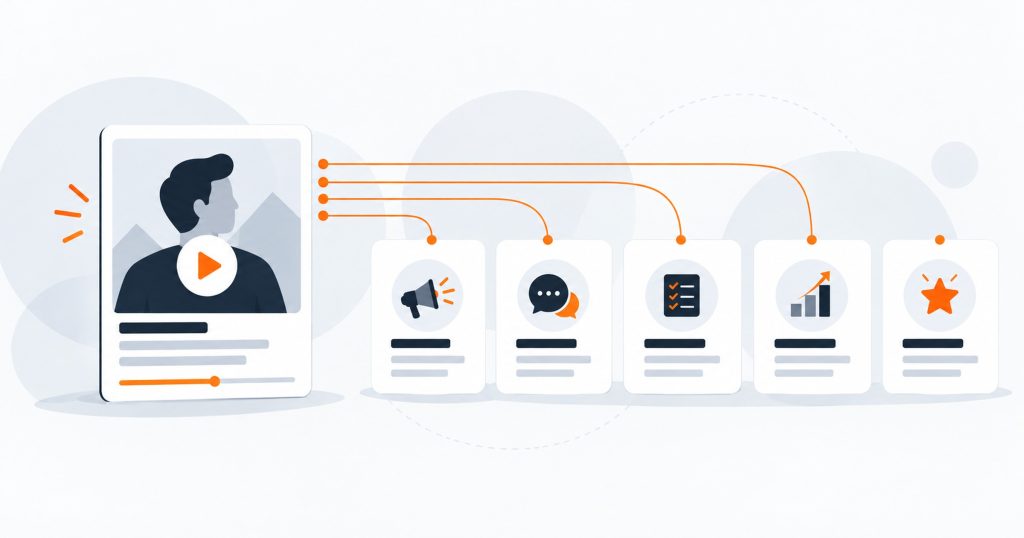
- Package each asset and give distribution an owner. Plan the derivatives while you produce, so one shoot or report becomes a short video, a data card, expert-led posts, a newsletter, an onboarding clip, and a sales one-pager, with one person accountable for getting them out.
- Measure influence and lifecycle outcomes. Track mentions, preference, and engagement for acquisition, and activation, adoption, retention, and expansion after the sale, not just clicks and leads.
Proof
We make B2B creative content built to be distributed across the whole journey, from our studios in Madrid and Bogotá, for clients worldwide. We produce video, motion, design, web, and interactive content, and the point is in how we build it: one shoot, report, or idea becomes a set of assets for different channels, different roles, and different stages, from the explainer that wins the shortlist to the customer-story film that drives a referral. We help marketing, communications, and commercial teams turn content they own into a distribution package with a clear home for each piece, so it reaches buyers early, holds up when they validate it, and keeps working after the sale, through onboarding, expansion, and advocacy. That is the real job heading into 2027: not making more content, but getting the right creative content in front of the right people at every stage, in search, in AI answers, and in the places they trust.
Frequently asked questions
Is content distribution only about acquiring leads?
How is content distribution changing for 2027?
Why does creative content matter more than written content alone?
What content do you need after the lead is acquired?
Is AI visibility enough, or do we still need proof?
Who should content be made for in a B2B buying group?
Get the right content in front of the right people at every stage
If you have the content but it is not reaching your buyers or your customers, we can help you prepare for how they will search and buy in 2027. Room4 Media makes B2B creative content built to be distributed and quoted, one production turned into a package of assets for every channel, role, and stage, from our studios in Madrid and Bogotá. Explore our video production work, see how we approach content strategy and content repurposing, or read what content distribution is.