























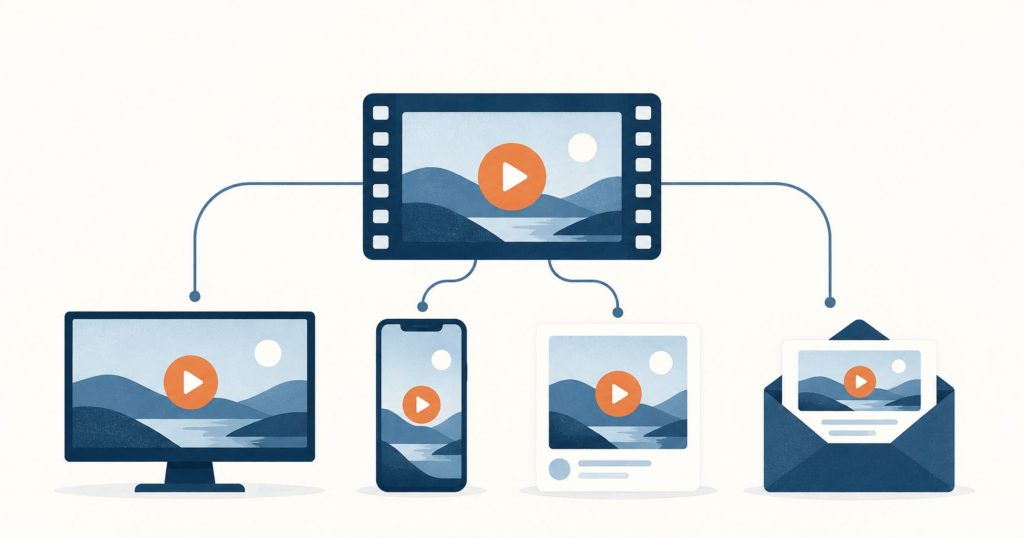
Video content distribution is how you get a finished video in front of the right buyers, across the channels where they actually watch. Most B2B teams spend their budget making the video and almost none planning where it goes, so a strong film ends up on one page and a single LinkedIn post, then stops.
The fix is not a bigger media budget. It is deciding the channels before the shoot, then leaving the edit with the right version for each one. Distribution is a production decision, not an afterthought.
Key Takeaways
- Decide the channels before you shoot. When distribution is planned first, one production leaves the edit as the right version for every place it needs to appear.
- One filmed asset should produce eight to ten channel-ready versions: a hero cut, short social cuts in square and vertical, a captioned sound-off edit, a teaser, and stills.
- Owned channels carry your video first, your site, email and company page; earned and paid extend it. Your marketing lead owns the media plan; the maker owns the versions that make it work.
- Most B2B video on social plays with the sound off, so a captioned, subtitled version is not optional; the message has to land muted.
- Repurposing a video library you already own is usually faster and cheaper than a new shoot. Audit what you have before you commission more.
Distribution starts in the edit, not after it
A single shoot is expensive to set up and cheap to re-cut. The waste happens when a team produces one long film, publishes it once, and never versions it. The same footage could have carried a LinkedIn feed cut, a vertical version for stories and paid, a captioned version for muted viewing, a short teaser, and a set of stills, all from one day of production.
So the first question is not “where do we post this” after the video exists. It is “which channels matter” before anyone books a crew. That answer sets the edit list, the aspect ratios, and the caption plan. Get it right and distribution is almost free, because every version already exists.
Where B2B video goes, and what each channel needs
| Channel | Best for | Version to deliver |
|---|---|---|
| LinkedIn feed | Reaching buyers and buying groups directly | 15 to 30 second cut, square or vertical, captioned |
| Website and landing pages | Explaining the product, holding attention on the page | Hero film, 60 to 90 seconds, 16:9 |
| Nurture, product updates, event follow-up | Thumbnail with a play button linking to the hosted video | |
| YouTube | Search, longer explainers, a home for the full film | Full 16:9 cut with chapters and a written description |
| Sales conversations | One-to-one follow-up, answering a specific objection | Short standalone snippet, 20 to 40 seconds |
| Events and webinars | Opening a session, recap content afterward | Full film plus a short highlight cut for promotion |
| Paid social | Extending reach beyond your own audience | 6 to 10 second teaser, vertical, hook in the first two seconds |
One production, many versions
This is the part most teams skip. A single day of filming, planned well, produces a full set of assets. Brief the cutdowns before the shoot so the framing works in both 16:9 and vertical, and so there is enough b-roll and clean audio to build every version.
| Deliverable | Length | Aspect ratio | Primary use |
|---|---|---|---|
| Hero film | 60 to 90s | 16:9 | Website, YouTube |
| Social cut | 15 to 30s | 1:1 and 9:16 | LinkedIn, Instagram |
| Paid teaser | 6 to 10s | 9:16 | Paid social, stories |
| Captioned sound-off cut | Matches source | 1:1 | Muted feed viewing |
| Sales snippet | 20 to 40s | 16:9 or 1:1 | One-to-one follow-up |
| Stills and quote cards | Static | Mixed | Posts, email, decks |
Owned, earned, and paid: who does what
Owned channels are the ones you control: your website, email list, company page, and sales team. They carry your video first and cost nothing to publish. Earned is coverage and shares you do not pay for. Paid is promotion you buy to reach beyond your own audience.
Here is the line that keeps this clean. Your marketing lead owns the media plan: which channels, what budget, what targeting. The production partner owns the versions that make the plan work: the right cut, the right ratio, captions, and the assets each channel needs. Room4 Media is the maker, not the media buyer. We build the set of versions so your team can put them everywhere without going back for a re-edit.
How to plan video content distribution
- Decide the channels first, before you brief a shoot. The channel list sets everything else.
- Map each channel to a version and an aspect ratio, so the edit list is agreed up front.
- Brief captions and a sound-off version from the start; do not add them later.
- Build a hero-plus-cutdowns edit list before the shoot, and confirm there is enough coverage to make every version.
- Split ownership clearly: the marketing lead runs the media plan, the production partner delivers the versions.
- Audit the video library you already own and repurpose it before commissioning anything new.
- Track what each channel returns, then feed that back into the next brief.
Which do you need: repurpose what you have, or produce for the channel
If you have a back catalogue of filmed material, start there. A lot of “new video” a team thinks it needs is already sitting in old footage that can be re-cut into current, channel-ready versions for a fraction of a new shoot. Repurposing is the faster, cheaper first move.
Produce for the channel when the gap is real: you have no footage for the message, the existing material is off-brand or dated, or the format the channel needs was never shot. In that case, plan the distribution into the production brief so the new shoot yields the full set of versions, not one film.
Proof
We produce for global brands from our studios in Madrid and Bogotá, and versioning for distribution is built into how we work. For a Europe-wide industry association we produced a policy explainer and cut it into short social versions and stills so one piece of work reached a multi-country audience across channels. For a global professional-services firm we made an animated explainer that ran on the website, in sales conversations, and across social from a single production. The pattern is always the same: one production, versioned for every place it needs to appear.
Frequently asked questions
What is video content distribution?
Does Room4 Media handle distribution, or just make the video?
How many versions should one video produce?
Do we need different videos for LinkedIn, YouTube, and email?
Is it better to repurpose old video or shoot new?
How do we distribute video without a big media budget?
Turn one production into a full set of channel-ready versions
Tell us your channels and we will plan the shoot so one production covers all of them. See how we build for reuse on our content repurposing and video production pages, learn the basics in our guide to content distribution, or look at the range of formats we produce under creative production.