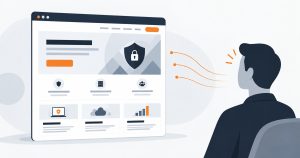
























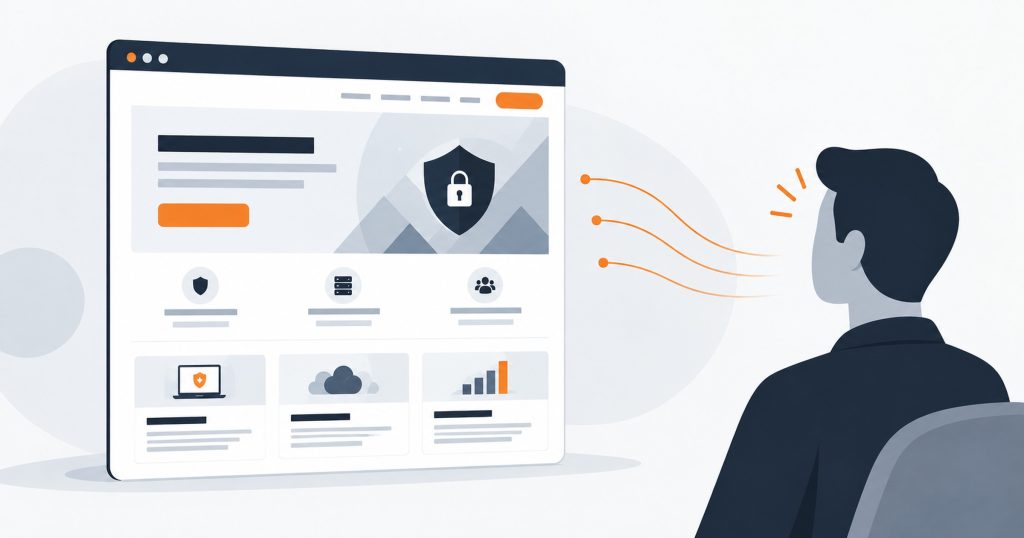
Your cybersecurity website has one job: attract and convert the buyers you want. For the marketing, commercial, and communication teams inside a cybersecurity company, good website design is not about taste. It is about understanding the security buyer you are trying to reach, the CISO, the security lead, the IT director, the procurement team, and designing the site around what they search for, the state of mind they are in, and the proof they need before they will trust a vendor. These buyers are skeptical by training and short on time. They see through marketing language fast, they want evidence before claims, and they increasingly ask AI engines to find and vet vendors for them. This guide covers what your buyers search for, how they think, what they really need from your site, and how to design it so it attracts your ICP, through search and through AI.
Key Takeaways
- Design for your buyer, not for taste. The job of a cybersecurity website is to attract and convert the security buyers you want: CISOs, security leads, IT, and procurement.
- Your buyers are skeptical and time-poor. They see through marketing language quickly and want proof before claims, so lead with clarity and evidence.
- Match how your buyers search and speak. They evaluate vendors with precise, comparison-led queries in their own security vocabulary, not generic marketing terms.
- Your buyers now use AI to shortlist vendors. If your site is not written so AI can read your category, proof, and differentiation, you are left off their shortlist.
- Serve both buyers in the room. The technical evaluator and the business approver both have to say yes, so give each the depth they need.
Who your buyers are, and what they search for
Start from the buyer, not the homepage. Your ICP is usually a security buyer: a CISO or security leader who owns the risk, an IT or engineering lead who evaluates the fit, and a procurement or finance stakeholder who approves the spend. They do not search like consumers. They search to evaluate and compare: the category and the specific need, your product against a named alternative, whether you meet the compliance they are accountable for, and whether other companies like theirs already trust you. A cybersecurity website that attracts them answers those evaluation questions directly, instead of describing the company in the abstract.
| How the buyer searches | What they are really after |
|---|---|
| “best [category] for [their industry or size]” | A vendor that clearly fits their exact situation |
| “[your product] vs [a named competitor]” | A clear reason to choose you over the alternative |
| “is [vendor] compliant with [standard]” | Proof you meet the standards they are accountable for |
| reviews, case studies, and customer names | Evidence that companies like theirs already trust you |
The state of mind your buyers are in
A security buyer arrives at your site cautious and pressed for time. They are accountable for risk, so a wrong vendor choice is personal, and they are wary of marketing that over-promises, because they have been burned before. A CISO can see through vague claims in seconds. They are not looking to be impressed; they are looking for reasons to shortlist you and reasons to rule you out, and they will rule you out fast if the site is unclear. So the site has to respect that mindset: say exactly what you do and who it is for, prove it before you claim it, keep the tone measured rather than alarmist, and make it easy to find the evidence they came for. Meet a skeptical, time-poor buyer with clarity and proof, not with a brand film.
What your buyers really need from your website
Underneath the search, your buyer needs three things from the site, fast. They need to understand what you do and whether it fits, without decoding jargon. They need proof that you are credible and that you meet their compliance bar: certifications, real case studies with outcomes, named customers, and recognition, placed where the claim is made rather than buried in a footer. And they need the site to serve two people at once, because the decision usually involves a technical evaluator and a business approver. Lead with the business value and the outcome, then give the technical depth a practitioner needs to approve you. If the site answers only one of them, the other cannot say yes.
| What the buyer needs | How the site delivers it |
|---|---|
| To understand the offer fast | A specific message, not security slogans or jargon |
| Proof of credibility | Certifications, compliance, and case studies with real outcomes |
| Reassurance it fits them | Named customers and examples from their industry |
| Depth for the technical evaluator | Layered content: business value first, then the technical detail |
How your buyers talk about the problem
Match your buyer’s language, because that is what both search engines and AI match against. Security buyers use precise terms: the category of product, the threats and risks they manage, the compliance standards they answer to, and the role language of their world. They do not search for “solutions” and “world-class protection”; they search for the specific thing they need, named the way their peers name it. When your site uses the buyer’s vocabulary, it ranks for what they type and reads as written by people who understand their job. When it leans on generic marketing language, a skeptical buyer reads that as a company that does not really get them, and moves on.
How your buyers now use AI to find and vet vendors
A growing share of vendor research starts inside AI engines. A security buyer asks ChatGPT or Perplexity for the best vendor in a category for their situation, or how two vendors compare, and the AI returns a shortlist with a reason for each. The vendors that appear are the ones whose sites and content state plainly what they do, who they serve, and the proof behind it, in a structure the AI can read and quote. If your category, your differentiation, and your evidence are vague or buried, the AI cannot summarise you, and you are left off the shortlist your buyer is building. Designing your site to attract buyers now means designing it so AI can understand and recommend you to them: clear statements of what you do, named proof, direct answers to the questions buyers ask, and content structured so an engine can lift it.
How to design your website to attract them
- Lead with a message your buyer recognises. State what you do, who it is for, and the outcome, in the buyer’s own terms. Cut the generic security slogans a CISO dismisses on sight.
- Structure around their evaluation questions. Map the pages to how your buyer decides: fit for their situation, comparison to alternatives, compliance, and proof, rather than a tour of the company.
- Put proof where the claim is. Place certifications, compliance, case studies with outcomes, and named customers next to the relevant claim, not only in a footer or a single badge row.
- Speak the buyer’s language. Use the category terms, risk language, and compliance standards your buyers search and talk in, so you match both their searches and their expectations.
- Build for AI discovery. Write clear entity statements, answer the real questions directly, and structure the content so AI engines can read and recommend you to the buyers asking them.
- Serve both buyers. Open with the business case and outcome for the approver, then give the technical depth the evaluator needs. Both have to say yes.
Proof
Room4 Media builds websites and content that help cybersecurity companies attract and convince their buyers, from our studios in Madrid and Bogotá, for clients worldwide. We rebuilt the website for ERM Protect, a cybersecurity and compliance firm, after 27 years of growth had left it with real authority and more than 90 pages of valuable content, but a site that had become a maze: the CISOs and compliance leaders it wanted to win could not quickly see what the firm offered. The positioning and the equity were right; the clarity was not. So rather than start over, we kept what 27 years had earned and rebuilt the structure around how those buyers actually decide, consolidating 90-plus pages into 30 focused ones across four buyer pathways. The firm’s buyers now understand the offering within seconds of landing. That is the real job of cybersecurity website design: making a trustworthy company easy for its buyers to understand, trust, and choose.
Frequently asked questions
What is the goal of a cybersecurity company’s website?
What do security buyers look for on a vendor’s website?
How do cybersecurity buyers search for vendors?
How do you get a cybersecurity company recommended by AI?
Should the website target the technical buyer or the business buyer?
Does a cybersecurity company need a website refresh or a full rebuild?
Want to attract better security buyers?
If your cybersecurity website buries the offer or leans on slogans instead of proof, your buyers are ruling you out before they understand you. Room4 Media builds B2B websites and content that make a trustworthy company easy for its buyers to understand, trust, and choose, from our studios in Madrid and Bogotá. Explore our web design work, see the ERM Protect website, read what makes good cybersecurity branding, or see how to choose a cybersecurity marketing agency.