























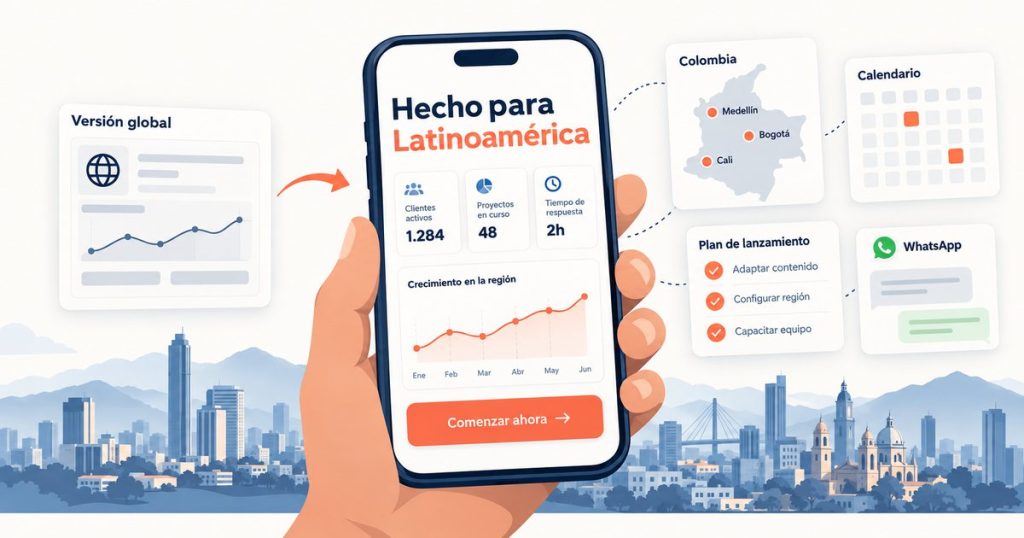
To go to market in Latin America, start in one country, learn how buyers there actually decide, and build from proof rather than guesswork. Colombia is a strong first market: it is Spanish-speaking, its business is concentrated in a few cities, and it is large enough to prove demand without spreading a small team across a dozen tax and regulatory systems at once.
This guide shows how to build a launch plan for a product or service in Latin America from what you already know, adapt the message country by country, and reach local buyers the way they expect to be reached.
Key Takeaways
- Pick one market first. Colombia gives you a Spanish-language base of about 53 million people, with business concentrated in Bogotá, Medellín and Cali.
- Start from what you already have, not fresh market research. Your sales calls, CRM, campaigns and search queries already show the objections that stop a sale.
- Localization adapts your marketing to a market; tropicalization re-tunes content built for the US or Europe so it reads as local in Latin America.
- Colombia is a relationship-led, trust-first market. Lead with proof and a message in Colombian Spanish, not a translated one.
- Build the plan before the assets. Decide the message, the buyer and the timing first, then produce the creative against a brief.
Why go to market in Latin America through Colombia
Colombia works as a first market because it keeps complexity manageable while demand is still unproven. It is Spanish-speaking, so the message and assets you build there carry into most of the region; 19 of the 20 Latin American countries use Spanish, and Brazil is the exception. Business is concentrated in a few centres, chiefly Bogotá, Medellín and Cali, so you can focus instead of selling to the whole country at once.
It is also a relationship-led market. Buyers reward personal relationships, trust and Spanish-first communication, and they do their due diligence before they commit (U.S. International Trade Administration, Colombia Market Entry Strategy, 2026). Prove the product or service in Colombia first, then carry the same Spanish-language base into Mexico, Peru or Chile. That order protects a small team from running several commercial environments before demand is clear. For the wider picture, see our guide to growth in Latin America.
Start from what you already have
Most launches stall because they begin with a blank page and a request for market research. You do not need to start from zero. The fastest way to a plan is to read what you already hold.
- Review your own evidence. Pull your sales call transcripts, CRM notes, current campaigns, existing assets and search queries from the target market.
- Interpret the objections. Name the specific reasons a deal stops: price and financing, proof and credibility, how you compare to local alternatives, technical depth. These repeat, and they are your real brief.
- Define who you are talking to. Set one clear buyer per market and region, not an audience of everyone.
- Localize the message. Adapt tone, vocabulary and cultural codes per country, inside your brand guidelines.
- Open avenues beyond paid media. Local partners, creators, chambers of commerce and events build credibility that ads alone cannot.
- Prioritize. Separate quick wins you can run in the first weeks from the bigger bets, and sequence them.
This turns scattered data into a plan you can act on, with a cost and an owner against each campaign. It is the same discipline behind a sound content strategy: decide the plan, then produce against it.
Localization and tropicalization: adapt the message, not just the words
Translation swaps the language. Localization and tropicalization change how the message lands.
Localization is the market-by-market work of adapting your content, pricing, channels and message so it reads as native to one place. Tropicalization is the Latin American form of that work: you take a campaign or an asset built for the US or Europe and re-tune the references, humour, visuals and offer so they feel local to the region, not imported.
| Approach | What changes | When to use it |
|---|---|---|
| Translation | The language only | Legal text, specs, anything factual |
| Localization | Message, pricing, channels, imagery and tone for one market | Entering a defined country |
| Tropicalization | Cultural re-tuning of US or Europe content for Latin American audiences | Reusing global assets across the region |
A translated campaign can be grammatically correct and still miss, because the proof points, the examples and the tone were built for a different buyer. For the full method, see how to localize your marketing for Latin America.
Who you are selling to, and what they need
You are selling to a buying group, not one person, and most of them will not have English as a first language. In Colombia the decision usually runs through a mid-level champion who builds the case and a senior approver who signs it off. Meeting how they decide is most of the launch.
| What buyers need | What it means for you |
|---|---|
| A message in their language | Communicate in Colombian Spanish, adapted per region, not translated |
| Proof before trust | Lead with credible local proof and clear outcomes, not claims |
| A relationship | Expect a relationship-led sale; plan for people and introductions, not only ads |
| A clear comparison | Say plainly how you differ from local alternatives |
| The whole buying group | Give the champion and the senior approver each the message they need |
| Familiar channels | LinkedIn, email, phone and WhatsApp are normal business channels |
The pattern underneath all of it is trust. Buyers do their due diligence and prefer a local introduction, so credible proof, a clear comparison and a message that sounds local do more for a first deal than another round of ads.
Plan around the local calendar and your launch cohorts
Business in Latin America runs on a calendar that does not match the northern one, from public holidays to budget cycles. Map the local commercial and cultural calendar against your own launch dates, cohorts or renewal windows, and time your biggest pushes to land when buyers are ready to act rather than when it suits head office. The same market-by-market reading sits behind our guide to B2B marketing in Colombia.
Which do you need: a plan first, or assets first?
If you are tempted to brief a video or a campaign straight away, slow down for one step. A plan first tells you which assets to make, for which buyer, in which city, around which date. Assets first means producing work and hoping it fits.
Build the plan, then produce against it: the localization guide, the calendar, the messaging by segment, the priority list, and a costed first-quarter action plan. Then the creative work has a brief it can be judged against.
Proof
We run these launches from our studios in Madrid and Bogotá, with local specialists in each market we cover. We start from your data, not a generic report: your calls, CRM, campaigns and search queries become a localization guide, a regional calendar, messaging by segment, and a prioritized action plan. Your branding team approves tone and brand; your in-market or paid media team runs the campaigns; we build the localized content and assets they need, and interpret the results so the next round is sharper. The work stays inside your brand and reads as local in each market.
Frequently asked questions
What is the best first market to launch in Latin America?
What is the difference between localization and tropicalization?
Do I need market research before launching in Colombia?
How do Colombian B2B buyers prefer to communicate?
How long until a Latin America launch works?
Can I reuse my existing campaigns in Latin America?
Planning a Latin America launch? Tell us the market and the product or service, and we will turn your existing data into a localized plan and the assets to run it.