























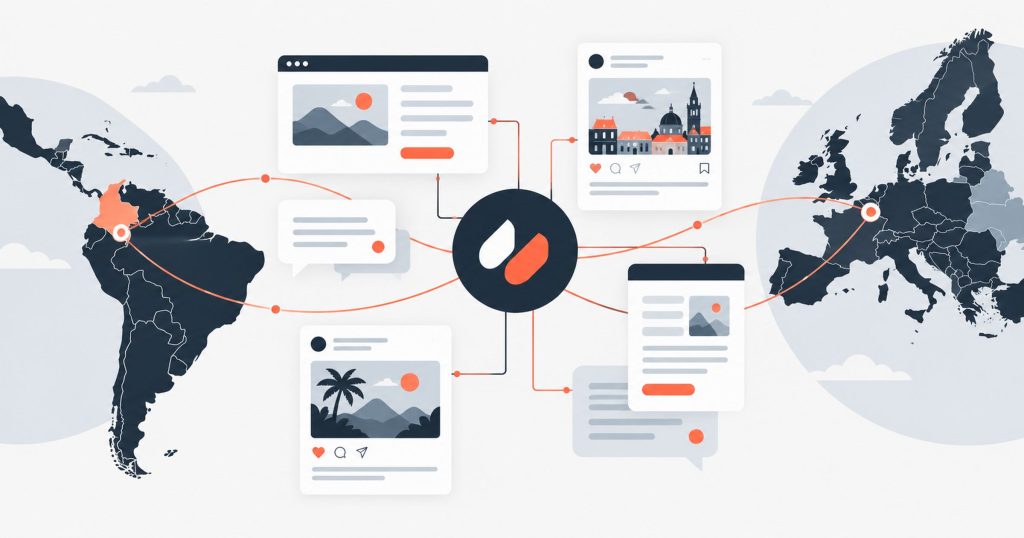
Localizing your marketing for Latin America is not translation. It is adapting three things to how buyers in the region actually decide: your marketing strategy, how you go to market; your communications, how you speak to buyers; and your content marketing, what you publish and where. The brand stays the same across every market. The way you make the case changes. A strategy, a message, and a content plan that convert at home in Europe or North America rarely convert the same way once they are simply translated. The reliable path is to start with one market, adapt until it works there, then carry what you learned into the next country. Colombia is a strong first market: a large B2B base, business concentrated in a few cities, and buyers who respond well to clear, Spanish-first messaging.
This guide explains what localization really means across strategy, communications, and content, why translation alone falls short, how to localize market by market, and why a team split between Europe and Colombia makes the work easier.
Key Takeaways
- Localization is not translation. It adapts your marketing strategy, your communications, and your content marketing to each market while keeping one brand. Translation only swaps the words.
- Translated marketing usually converts worse in the region, because the objections, the proof buyers trust, and the buying culture are different from your home market.
- Start with one market and get it working before you scale. Colombia is a strong first step for B2B: a large base, concentrated business centres, and buyers who reward Spanish-first communication.
- Each country is its own market. Buying culture, trust signals, preferred channels, and timing differ from one country in the region to the next.
- A partner with people in both Europe and Colombia keeps the brand coherent at the source and the strategy, communications, and content accurate on the ground.
What does it mean to localize your marketing for Latin America?
Localizing your marketing means adapting the whole approach to a new market, not just the language. It runs across three layers. Your marketing strategy has to match how buyers in the region find, evaluate, and choose, including which channels carry weight there. Your communications have to answer what local buyers actually care about, in the tone and language they trust. And your content marketing has to publish the right things, in the right formats, on the platforms buyers in that country use. Through all of it, the brand stays the same; only the way you reach and persuade changes.
Translation is one part of this, and the smallest part. A translated page says the same thing in Spanish. Localized marketing says the right thing for a buyer in the region: the objection they actually raise, the proof they trust, the channel they are on, the way they expect to be approached. In Latin America that matters more than most home markets assume, because buyers there weigh trust and relationships heavily, and respond to messaging that feels conversational rather than transactional.
| Translation | Localization | |
|---|---|---|
| What changes | The words | The strategy, communications, and content |
| Goal | The page reads correctly in Spanish | The marketing converts a local buyer |
| Channels | Kept from the home market | Chosen for where local buyers are |
| Proof and references | Kept from the home market | Chosen to feel relevant locally |
| Brand | Unchanged | Unchanged, and that is the point |
Why translated marketing converts worse in the region
A strategy and a message built for a home market carry assumptions that do not travel. The objections are different, so communications that answer a European buyer’s hesitation can skip the one a Colombian buyer actually has. The proof is different, because the brands, case studies, and credentials that build trust at home may mean little in the new market. The channels are different, with buyers active on platforms and in formats your home plan may not prioritise. And the buying culture is different: how long the decision takes, who is involved, and how much relationship a buyer expects before they will talk to sales.
That is why a company with strong, proven positioning at home can see its conversion fall when it enters the region with translated material. The brand is fine. The marketing is not meeting the local buyer where they are. The fix is not a louder campaign; it is strategy, communications, and content adapted to the market, tested there, and corrected until they work.
How to localize your marketing, market by market
- Start with one market. Pick a first country and commit to it rather than launching across the region at once. Colombia is a strong starting point for B2B: a large base, business concentrated in a few cities, and buyers who reward clear, Spanish-first communication.
- Map the local buyer. Learn the objections, the trust signals, the channels, and the decision path in that country. Look at how buyers in-region actually search and decide, not just a market report, and talk to local buyers or the people who sell to them before you write a word.
- Adapt the strategy. Rework your go-to-market for how buyers there find and choose, including which channels carry weight locally, while holding your positioning and core story steady.
- Localize the communications. Rewrite the message for the local buyer in natural, persuasive Spanish, with native speakers who adapt tone and style, not just the words, so it reads as if it was written for that market.
- Rebuild the content and proof. Publish the formats and examples a local buyer recognises and trusts, on the platforms they use, instead of carrying over home-market content that does not land.
- Test, correct, then carry it forward. Put the localized marketing live, watch how local buyers respond, fix what underperforms, and then adapt what worked for the next country, treating each one as its own market.
What to adapt and what to keep
Latin America is not one market, and marketing that works in Colombia will not automatically work in the next country. Buying culture differs, trust signals differ, preferred channels differ, and so does the timing that puts buyers in a receptive mood. Localizing for the region means localizing for each country in it, which is why starting with one, getting it right, and then adapting is more reliable than a single regional launch. The rule is simple: adapt how you reach and persuade, keep who you are.
| Adapt | Keep |
|---|---|
| The go-to-market strategy and the channels you use | Your positioning and core story |
| The communications: message, tone, and language | Your visual identity and brand voice |
| The content, formats, proof, and timing | Your name and brand promise |
| The objections you answer for the local buyer | The quality bar across every market |
Why a team in both Europe and Colombia helps
Localization has two failure points. The brand can drift, so each market ends up telling a slightly different story and the company loses coherence. Or the marketing can miss the market, because whoever built the strategy, wrote the communications, or planned the content does not know how local buyers actually decide. A team split between Europe and Colombia addresses both. The brand is held at the source, close to where the company and its positioning live, and the strategy, communications, and content are made on the ground, by people who know the local buyer and the local channels. The time zones overlap for several working hours a day, so the two sides coordinate in real time instead of waiting overnight for answers.
Proof
We localize marketing for Latin America from our studios in Madrid and Bogotá: the strategy, the communications, and the content marketing, not just the language. A typical engagement starts with a company that has strong, proven positioning at home in Europe or North America and a complex offer to explain, entering the region for the first time and unsure how its marketing will land. We start with one market, usually Colombia, and adapt the go-to-market, the message, and the content to local buyers while keeping the brand coherent. The Madrid side holds the brand at the source; the Bogotá side makes the marketing accurate on the ground. That split, and starting with one market before scaling to the next, is how we keep a brand consistent while its marketing actually converts in each country.
Frequently asked questions
What is the difference between translating and localizing your marketing?
Why should we start with Colombia when entering Latin America?
Why does marketing that works at home convert worse in Latin America?
Is it enough to localize our content, or do we need to localize the strategy too?
How do we keep our brand coherent while localizing for each market?
Why work with a partner that has a team in both Europe and Colombia?
Entering Latin America?
If you are taking a proven B2B brand into Latin America and want the marketing to convert, not just read correctly, we can help. We localize the strategy, communications, and content marketing for each market from our studios in Madrid and Bogotá, starting with one country and scaling from there. Explore our bilingual creative partner work, see how we act as a nearshore creative partner in Latin America, read about creative production in the region, or learn our approach to content strategy.