























Our last guide said to start your Latin America push with one market, and that Colombia is a strong first choice. This is how you actually market and sell there. The short version: Colombia is a relationship-led, hierarchical B2B market. Deals move through a buying committee and need sign-off one or two levels above your day-to-day contact, Spanish is the operating language, and trust is built before demand scales. So you start narrow, with one city and a sharp ideal customer profile; you map both the person who champions you and the person who approves the budget; you reach them through a mix of LinkedIn, email, phone, and warm introductions; and you plan for a longer cycle than at home. Companies that translate their existing campaign and expect home-market speed stall. Companies that localize the strategy and work the way Colombian buyers actually buy build real pipeline.
Treat this as a communication strategy, not just a marketing plan. The strategy decides who you talk to; the communication decides whether they trust you, and that is where most foreign entries are won or lost. This guide covers how to start, how to define and target your ICP, who the buyers are, how to communicate and localise your message, how a deal actually gets done, how to reach people, and how long it takes.
Key Takeaways
- Colombia is relationship-led and hierarchical. Deals run through a buying committee and need approval one or two levels above your everyday contact, so map the whole committee early.
- Start narrow. Pick one city, one or two sectors, and a sharp ICP, prove the strategy there, then scale.
- Communication comes first. Localise the message, not just the language: rewrite it in Colombian Spanish, tailor it to each decision-maker, and keep one consistent story across every channel.
- Profile your ICP on the usual firmographics plus local signals: financial solidity, payment and financing terms, digital maturity, and whether they already buy from international suppliers.
- Target two people per account: an operational champion who runs the evaluation, and a senior approver who signs the budget.
- Reach buyers through LinkedIn, corporate email, and phone, and above all through warm introductions from local partners, chambers of commerce, trade associations, and existing clients.
- Expect a longer cycle. Written recaps within 24 hours, steady follow-up, and patience win in a market that runs on trust.
How to start: a beachhead and a sharp ICP
Do not launch across Colombia at once. Pick a beachhead: one or two sectors where your expertise is strongest, one use case with clear economic value, and one city to start. Bogotá concentrates large corporates, finance, and government; Medellín is the technology and innovation hub; Cali leans to manufacturing and food processing; Barranquilla and Cartagena are the Caribbean trade, logistics, and port centres. Choose the city where your target sector is densest, prove the approach there, then expand.
Then define your ideal customer profile. Use the firmographics you would anywhere, and add the local signals that decide whether a Colombian company is a good fit and can actually buy. Before you write a word of outreach, validate the profile against five to ten of your best current customers and interview buyers in the segment: which business problem creates budget, who initiates and who approves, what proof a foreign supplier must show, which local alternatives they already trust, and what blocks the deal.
| Standard firmographics | Colombia-specific signals |
|---|---|
| Industry or vertical that buys and renews most | Financial solidity and payment or financing terms |
| Company size: headcount and annual revenue | SME versus large family group or listed company, which change cycle and budget |
| Location, and whether they operate locally or nationally | Digital maturity: updated website, active corporate LinkedIn, use of procurement portals or RFPs |
| Current tech stack and the specific pain you solve | Whether they already buy from international suppliers or run structured procurement |
Who you are selling to: the buyer and the committee
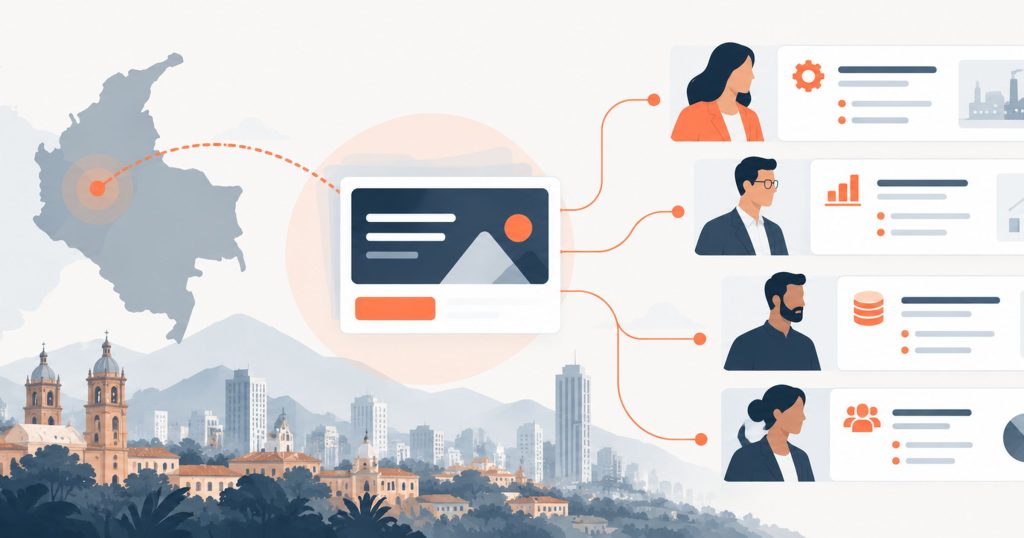
In Colombian B2B, decisions usually pass through a buying committee and need approval from senior levels. Do not assume your day-to-day contact decides alone. In practice a mid-level manager, often the head of procurement or an area manager, leads the evaluation and champions your proposal internally, while final approval comes one or two levels up: the general manager, the CFO, or, in family-owned companies, the owner. That means you target two people per account from the start: the champion who runs the evaluation and the senior approver who signs the budget.
It also helps to know the titles people actually hold, so you can find them on LinkedIn and address the right person. These are the common Colombian titles by function, in Spanish as they appear on profiles and org charts.
| Function | Common titles (search these on LinkedIn) | Role in the deal |
|---|---|---|
| General management | Gerente General, Director General, CEO, Presidente | Final approval, especially in family-owned firms |
| Operations and commercial | Director or Gerente de Operaciones, COO, Director or Gerente Comercial | Owns the business need and influences the choice |
| Procurement | Gerente or Jefe de Compras, Director de Abastecimiento, Gerente de Procurement | Runs the evaluation, often your internal champion |
| Finance | CFO, Director Financiero, Gerente Financiero, Controller | Signs off on cost, terms, and financing |
| IT and technology | CIO, Director de TI, Gerente de Sistemas, Director de Transformación Digital | Technical evaluation and fit with the stack |
| Marketing and growth | Head or Director de Marketing, Gerente de Marketing, Marketing Manager | The buyer for marketing and creative services |
How to communicate and localise your message
Marketing in Colombia is a communication problem first. You can target the right companies and still lose them if the message does not land, because localising a message is not translating it. You rewrite it in Colombian Spanish, for the local buyer, reviewed by someone in the market, so it reads as if it was written there rather than imported.
Three things make Colombian business communication different. It is relationship-first, so the message opens with context and credibility before the ask, rather than leading with the takeaway on line one. It is moderately formal, so the tone stays professional and courteous and avoids slang or phrasing that sounds imported from Spain, Mexico, or the United States. And it is proof-led, so local references and specific, measurable results carry more weight than claims.
Then tailor the message to each person on the committee. It is still one story, but told in the terms each decision-maker cares about. That is what keeps the brand coherent while still speaking to what each person needs in order to say yes.
| Decision-maker | What they need to hear |
|---|---|
| Operations and commercial | The business outcome: how it solves their problem and what changes for their team |
| Procurement (your champion) | A clear, comparable case they can defend internally against other suppliers |
| Finance | Cost, payment terms, financing, and the measurable return |
| IT and technology | Fit with their stack, implementation, and risk |
| General management or owner | Trust, track record, and that you will still be there after the sale |
Keep the message consistent across every channel, from the first LinkedIn note to the proposal to the room, so a buyer hears one story wherever they meet you. That is the point of localising: adapt how you say it to Colombia and to each role, and keep what you stand for the same everywhere. This is the work we spend most of our time on with clients entering the region, shaping the communication strategy and localising the message, before and alongside the content that carries it.
How business actually works in Colombia
A typical B2B purchase moves through five stages, and your job is to be present and trusted at each one.
- Need recognition. An operational or strategic area identifies the problem and the budget to fix it.
- Research and shortlist. Procurement and operations build a shortlist of three to five suppliers.
- Evaluation. A buying committee of two to five people, usually from operations, procurement, IT or engineering, and finance, assesses the technical and commercial fit.
- Negotiation. The committee negotiates with two or three finalists on price, payment terms, deadlines, warranties, after-sales service, and training.
- Decision and close. Final sign-off comes from management, the CFO, or the general manager.
Ask about the approval route early and directly: who else needs to see this before it is approved, and what does the CFO need in order to sign. It saves weeks.
The culture is relationship-driven and moderately to strongly hierarchical. Personal trust is essential, and negotiations advance gradually, so avoid open confrontation, stay diplomatic, and look for consensus. Respect titles and levels, and put senior people from your side in the room; for first meetings, a senior executive from your company should attend. Schedule two to three weeks ahead, confirm before you travel, and send a structured agenda about 48 hours before with attendees and the expected outcome. Arrive on time, especially in Bogotá, dress formally, and expect a few minutes of personal conversation before the agenda. If only an operational contact receives you, ask explicitly who else must see the proposal. Confirm verbal agreements in writing, and send a written recap within 24 hours with participants, decisions, and next steps. Then keep a steady, respectful follow-up rhythm; cycles can be long and reward patience.
How to reach and target buyers
The channel mix leans more on relationships and local credibility than most home-market plans do. Digital supports the relationship rather than replacing it. Lead with warm introductions, back them with direct channels, and keep everything in Spanish.
| Channel | How to use it |
|---|---|
| Referrals and local networks | The fastest path to trust: introductions through partners, chambers of commerce, trade associations, and existing clients |
| Search by title, industry, and city; connect with a personalised note, then a short, specific message. Sales Navigator helps filter | |
| Corporate email | Use a verified domain and a professional signature; a company address lands better than a generic one |
| Phone | Still used to arrange and confirm meetings; many companies confirm by phone before they commit to a calendar slot |
| A normal business follow-up channel for fast, personal communication after first contact | |
| Events and associations | Chambers, trade bodies, and sector events; use trade shows to build relationships and arrange meetings, not just collect leads |
| Spanish search and website | Spanish landing pages and local SEO so buyers researching you find a page written for them |
Put it together as a simple outreach sequence you can run this week:
- Write an ICP hypothesis and list 30 to 50 companies that fit by industry, size, and city.
- Find two to three contacts per company: an operational champion, such as the head of procurement or the area manager, plus a senior approver, such as the general manager or CFO.
- First touch on LinkedIn or email: a short message specific to their sector and the problem you solve. Skip the generic pitch. A line like “I saw that your company is doing X; we helped a similar company achieve Y, and I have two ideas for your operation in Bogotá” works because it is specific.
- Follow up in 48 to 72 hours with something useful, a short case, a benchmark, or a checklist, and propose a 15-minute call.
- If there is no reply, rotate the channel, from LinkedIn to email to phone, and ask for an internal referral: “Who would you recommend I speak with to evaluate this?”
How long until it works
Set expectations before you start. Marketing in Colombia rewards consistency, and pipeline builds over months rather than weeks. Plan for several months of steady, localized outreach before meetings and opportunities stabilise, and for first deals to land roughly six to twelve months out, depending on size and complexity. That is not slowness; it is the cost of the trust that makes Colombian deals durable once they close. The companies that quit at week six are usually the ones who expected home-market speed.
Proof
We do not just run marketing in Latin America; we help shape the communication strategy and localise the message, then make the content that carries it, from our studios in Madrid and Bogotá. Colombia is where most engagements start. The Bogotá team rewrites the message in Colombian Spanish and adapts the proof and the channels for local buyers; the Madrid side keeps the brand coherent at the source. A typical engagement begins with a company that has strong positioning at home and no clear read on how to say it in Colombia. We help pick the beachhead, define the ICP, shape how the company communicates to each decision-maker, and build the proof local buyers trust, so the brand stays consistent while the message actually converts on the ground.
Frequently asked questions
How should we start marketing in Colombia?
Who makes the buying decision in Colombian B2B?
What job titles should we target in Colombia?
How do you localise your message for Colombian buyers?
How do you reach and connect with B2B buyers in Colombia?
How is a B2B deal actually done in Colombia?
How long does it take to win business in Colombia?
Marketing into Colombia?
If you are taking a proven B2B brand into Colombia and want the marketing to convert, not just read correctly, we can help. We localize the strategy, communications, and content for the market from our studios in Madrid and Bogotá, with a team on the ground where your buyers are. Read how to localize your marketing for Latin America, see how we act as a nearshore creative partner in Latin America, explore our bilingual creative partner work, or learn our approach to content strategy.