




















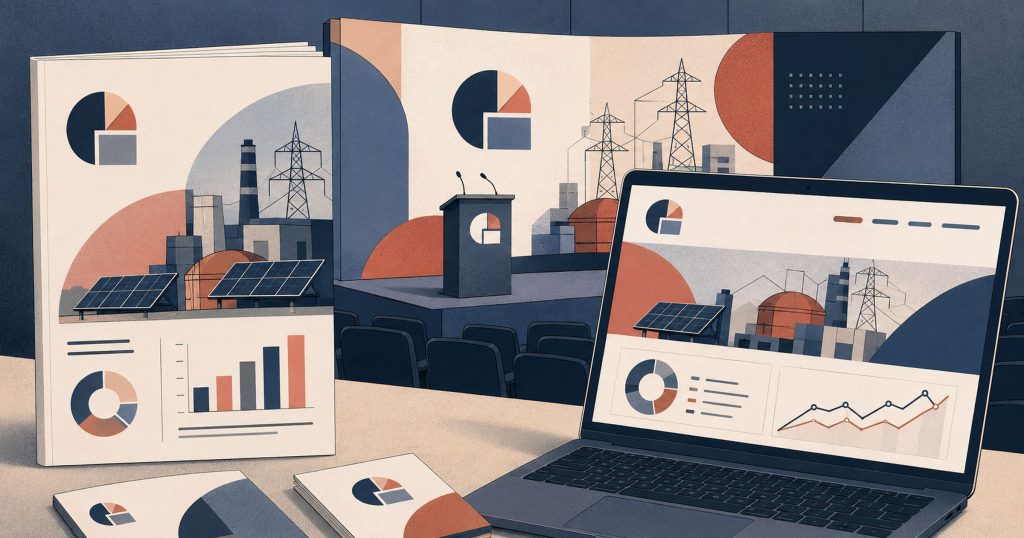
Renewable energy branding is the system of positioning, messaging and visual identity that makes a technical energy business understood and trusted by the people who decide its future: policymakers, investors, commercial buyers and engineers. It is not a green colour palette and a leaf.
The job is harder than in most sectors, because the subject matter is technical, the audience is mixed, and the language everyone reaches for is about to become a legal risk.
Key Takeaways
- Renewable energy branding is the system of positioning, messaging and visual identity that makes a technical energy business understood and trusted by policymakers, investors and commercial buyers.
- From 27 September 2026, EU member states apply rules that prohibit generic environmental claims such as “eco-friendly”, “green”, “climate friendly” and “carbon friendly” unless the business holds recognised excellent environmental performance relevant to the claim (Directive (EU) 2024/825).
- That removes most of the vocabulary currently sitting on renewable energy websites, so the brands that win will be the ones showing evidence instead of adjectives.
- Your audience is mixed. A policymaker, an investor, a commercial buyer and an engineer read the same page, and each needs a different proof point in language they can act on.
- Room4 Media built the visual identity, brand manual and website for the European Aluminium Summit 2025, and made a 1.5-minute CBAM explainer that reached EU policymakers who had no time for another technical paper.
The green adjectives are running out
On 27 September 2026, EU member states begin applying Directive (EU) 2024/825. It prohibits making a generic environmental claim unless the business holds recognised excellent environmental performance relevant to that claim.
The directive names the words. Its examples of generic environmental claims include “environmentally friendly”, “eco-friendly”, “green”, “nature’s friend”, “ecological”, “environmentally correct”, “climate friendly”, “gentle on the environment”, “carbon friendly”, “energy efficient”, “biodegradable” and “biobased”. It also targets sustainability labels that are not transparent or credible.
Read your own homepage against that list. Most renewable energy and cleantech sites are built almost entirely from those words. From September, they stop being safe filler and start being a claim you have to substantiate.
This is a branding problem before it is a legal one. Strip out the adjectives and many renewable brands have nothing left to say, because the adjectives were doing all the work.
What to say instead
| Generic claim (restricted from 27 Sep 2026) | What to say instead |
|---|---|
| “Eco-friendly solutions” | The specific outcome, measured: what it reduces, by how much, against what baseline |
| “Green energy for a better future” | What you supply, to whom, and where it comes from |
| “Climate friendly technology” | The verified figure, the method used, and who certified it |
| “Sustainable by design” | The design decision itself, and what it changed |
| “Carbon friendly” | The carbon number, its scope, and the standard it was calculated under |
| An unexplained sustainability badge | A named certification, with the body and the date |
The pattern is the same one that separates strong B2B brands everywhere. Adjectives are what everyone claims. Evidence is what gets you believed.
The sea of sameness in renewable branding
Beyond the language, the sector looks alike. The common mistakes:
- The same visual shorthand: a leaf, a turbine, a sunrise gradient, and a palette of green and blue. It signals “renewable” in general and your company in particular not at all.
- Nature imagery with no work in it. Stock landscapes tell a buyer nothing about whether you can deliver.
- Technical density with no translation. Papers full of statistics and charts that the decision-maker has neither the time nor the background to read.
- A brand built for one audience. Usually the engineer, which leaves the investor and the policymaker guessing.
One brand, four readers
In renewable energy and cleantech the buying group is unusually wide, and it includes people who do not buy at all but can stop you, such as regulators. The brand has to work for each of them at once.
| Who is reading | What they need to see |
|---|---|
| Policymaker or regulator | The issue explained fast and accurately, without lobbying tone. Most have no technical background and no time |
| Investor | The commercial case, the scale of the opportunity, and evidence the claims hold up |
| Commercial buyer | What you supply, what it costs, what it replaces, and proof you can deliver at volume |
| Engineer or technical lead | Real specification and method, not marketing language |
If your brand only speaks to one of these, the others fill the gap with assumptions, and the assumptions are rarely generous.
What good renewable energy branding includes
Positioning that states what you do, who you serve and what you have actually delivered. Messaging that survives the removal of every green adjective. A visual identity that is ownable rather than sector-generic. Then the system that holds it together: brand guidelines, sales and investor materials, web assets, and templates so the same standard holds when the team grows.
The differentiator in this sector is clarity. Almost everyone is selling something technical to someone who is not technical. The business that gets understood first tends to get chosen.
How to build it: a five-point check
- Audit your copy against the directive’s list before September. Every generic claim either gets evidence attached or gets cut.
- Fix positioning before design. Define what you do, who you protect or supply, and what you have delivered.
- Write for the four readers. Each needs one clear proof point, in language they use.
- Build an identity that would still be recognisable in black and white, without a leaf.
- Document the system, so consistency survives growth, agencies and time.
How Room4 Media works in this sector
Room4 Media makes the video, branding and web work for cleantech and industrial decarbonisation clients, including European Aluminium.
For the European Aluminium Summit, the brief was to build a premium digital presence from scratch, speak to C-level executives, engineers and sponsors in one clear voice, and translate themes like policy innovation and traceability into something people would engage with, on a tight launch timeline. Room4 Media designed the visual identity, a minimalist system reflecting industry leadership and sustainability, plus an event brand manual aligned to the European Aluminium brand. We then designed and built the website and UX to drive registrations and support sponsor and media engagement, produced the on-site and digital assets, and integrated Swapcard so speaker bios and the agenda stayed current. It launched on time and on brand, and gave European Aluminium one toolkit for outreach and stakeholder alignment.
The CBAM explainer video is the clarity problem in its purest form. European Aluminium needed EU policymakers to understand how the Carbon Border Adjustment Mechanism affects the aluminium sector. Their written papers, dense with statistics and charts, were not getting attention, because most decision-makers had neither the time nor the technical background to work through them. Instead of another paper, Room4 Media made a 1.5-minute explainer using simple visuals and a calm, factual voice: why aluminium is affected differently, how loopholes distort the system, and what changes would make the rules work. It reached a wider group of policymakers and turned a technical argument into something understood in under two minutes.
That is what this sector actually rewards. See more renewable energy and cleantech creative work, or the wider B2B branding and visual identity practice. Room4 Media works from studios in Madrid and Bogotá, delivering to clients worldwide.
If your renewable energy brand is built on words you will not be able to defend in September, start a conversation with Room4 Media about replacing them with evidence.